
Umbrella Insurance: Cheap Protection for Everything You've Built
Why your financial advisor is talking about insurance
One lawsuit can wipe out years of saving faster than any market drop. Most of our work together goes into growing your money, so I want to make sure it's also protected from the unexpected.
An umbrella policy is one of the cheapest ways to do that. It's also one of the easiest to overlook, because you only notice it when something goes badly wrong.
What it is, in plain English
Umbrella insurance is extra liability coverage that sits on top of your auto and homeowners policies. If you're found responsible for injuring someone or damaging their property, your regular policy pays first. Once that limit is used up, the umbrella pays the rest, up to its own limit. It generally covers claims caused by members of your household, too, not just you. That matters if you have kids, and especially teen drivers.
Many umbrella policies also cover claims your other policies won't touch, such as being sued over something you said or posted online. They can help with legal defense costs, too. Every insurer writes these a little differently, so the fine print matters.
How it works: a quick example
Say your auto policy covers $300,000 of liability. You cause a crash, and the other driver is awarded $1.2 million. Here's how that plays out with and without a $1 million umbrella:
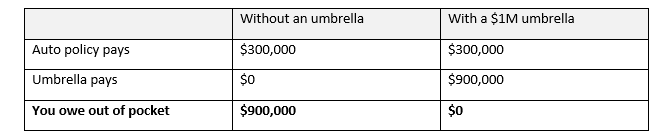
That $900,000 would have to come from your savings, your investments, and possibly your future paychecks. That last part surprises people: a court judgment can follow your income for years.
Who should seriously consider it
A helpful benchmark from Schwab: if your household earns around $250,000 a year or more, it's worth carrying at least a basic umbrella policy. Premiums are low enough that the math usually favors it.
Whatever your income, it deserves a look if any of these describe you:
• You have meaningful savings or investments outside your 401(k)
• You earn a strong income, or expect to for years to come
• You own a home, and especially if you own rental property
• You have a pool, trampoline, or a dog
• You have a teenage driver in the house
• You coach youth sports, volunteer, or host a lot of get-togethers
• You're active on social media or in your community
• You ski, hunt, boat, or do other activities where others could get hurt
One note for business owners: a personal umbrella usually does not cover your business activities. Those need their own business liability coverage.
How much coverage is enough
There's no single right number, but two well-known rules of thumb give you a sensible range to start from.
Rule of thumb 1: the quick check (Schwab)
Schwab suggests carrying total liability coverage of one to two times your net worth. "Total" means your umbrella plus the liability limits on your home and auto policies combined.
Rule of thumb 2: protect what's exposed (Fidelity)
Fidelity takes a more targeted approach: cover your net worth, but leave out assets the law already shields from creditors, and factor in your future income. Here's a simple worksheet for it:

Why those subtractions? Employer retirement plans like 401(k)s and pensions have strong federal protection from lawsuits. IRAs and home equity are different: how well they're protected depends on the state you live in. That's one of the things we can sort out together, because it can change the answer a lot.
Putting both rules side by side
Here's how the two rules play out for a sample family: $2 million net worth, including $600,000 in 401(k)s and $400,000 of home equity their state protects, with $300,000 of auto liability coverage.
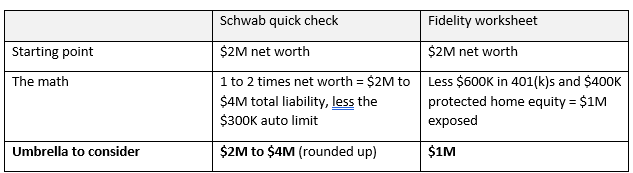
Use these two as the low and high ends of a range. For this family, that's $1 million to $4 million. Then have a conversation with your advisor about where in that range makes sense for you, based on your income, your risks, and where you live.
Important: Creditor protection rules differ by state. How much of your IRA, home equity, and other assets is shielded from a lawsuit depends on where you live, so research your local laws, ideally with an attorney, before making a decision.
What it costs, and how to pay less
The first $1 million of coverage typically runs a few hundred dollars a year, and each additional million usually costs less than the one before. Insurers can keep the price low because they only pay after your other policies are exhausted, which is rare. That's also why an umbrella is usually a better deal than simply raising the liability limits on each of your policies, which gets expensive quickly.
A few things to know before you shop:
Bundle it. Buying your umbrella from the same company that covers your home and cars usually earns a discount.
Expect minimums. Most insurers require your auto and home policies to carry a certain amount of liability first, often in the $250,000 to $300,000 range.
Raising those minimums costs money too. Factor that into the total price when you compare quotes. Prices vary by insurer, state, and your household, so treat these as ballpark figures.
Mistakes I see people make
Letting a gap open up. If you switch carriers or lower the liability on your auto or home policy, you can fall below what your umbrella requires. The umbrella may then pay less than you expect, or nothing at all.
Mismatched renewal dates. Policies that renew at different times are easier to let slip. Keeping everything with one company on one schedule helps.
Not updating it after life changes. A new teen driver, a rental property, or a big jump in net worth are all reasons to revisit your limit.
Assuming it covers everything. Umbrellas don't cover your business, intentional acts, or damage to your own property. Board members and self-employed professionals may need separate coverage.
Your next step
Before our next review, pull the declarations pages for your auto, home, and any umbrella policy you already have. We'll look at them alongside your full financial picture and see whether your coverage matches what you've built. If you have questions before then, just give us a call.
JAMES GRIFFIN, MBA, CFP®, Managing Principal, Occidental Asset Management
Written on September 30, 2026
This article is for general educational purposes and is not insurance, legal, or tax advice. Coverage terms and costs vary by insurer. Creditor protection rules differ by state, so research your local laws before making a decision. Talk with a licensed insurance professional or attorney about your specific situation.
Sources
• Fidelity Viewpoints, Do you need umbrella insurance? (March 13, 2026)
• Charles Schwab, When Do You Need Umbrella Insurance? (June 18, 2026)