
Written by James Griffin · Oct 23, 2026
Why This Matters
Three military retirement decisions are effectively permanent: your pension, which gets fixed by your retirement date; your Survivor Benefit Plan (SBP) election; and your Thrift Savings Plan (TSP), which locks in a quieter way.
The first two land in the same stack of paperwork, usually in the same few weeks you're job hunting, moving the family, and closing out a 20-plus-year career. Outside a narrow set of exceptions, neither one reopens. The third never asks for a signature, which is exactly why it gets missed.
In our experience, the mistakes here are rarely about not caring. They come from not seeing how the three pieces fit together before the paperwork gets signed. This post walks through what each one locks in, how they affect each other, and what to check before you sign.
If you're separating before 20 years with no pension coming, the TSP section still applies to you. The rest can wait.
Prefer to watch? This post goes with our video, The Three Military Retirement Decisions That Can't Be Undone, on YouTube.
What Are the Three Decisions?
They're the three pieces of your retirement that get set in the same window and are hard or impossible to reverse afterward.
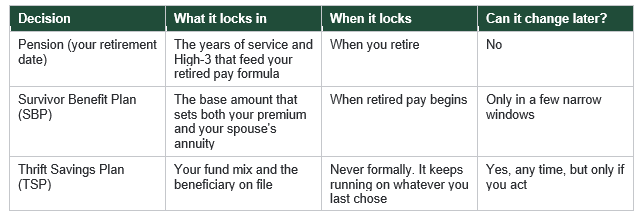
The pension. Retired pay is a formula: years of service, times a multiplier, times your High-3 (the average of your highest 36 months of basic pay). The multiplier is 2.5% per year under High-3 and 2.0% per year under the Blended Retirement System, or BRS (DoD Military Compensation). Once you retire, those inputs stop moving.
SBP. SBP pays your surviving spouse 55% of the base amount you elect, for life, with the same cost of living adjustments your retired pay gets. The premium is 6.5% of that same base amount (DoD Military Compensation). If you're married, declining or reducing coverage requires your spouse's written agreement.
The TSP. Nothing about your TSP forces a decision at retirement. That's the catch. A fund mix you picked as an O-3 and a beneficiary named before a marriage, divorce, or new child will keep running until you change them.
A Simple Example
Take an O-5 under High-3 deciding between retiring at 23 years or staying for 24. The only thing that changes is the retirement date.
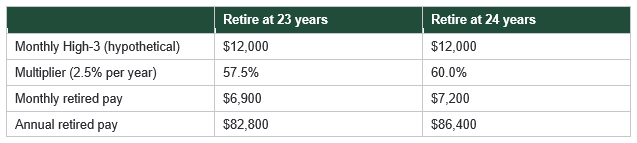
The extra year is worth $300 a month, or $3,600 a year, for life. Over 30 years of retirement that's roughly $108,000 before cost of living adjustments. Under BRS, the same year is worth 2.0% instead of 2.5%, or $240 a month at the same High-3.
Once the paperwork is signed, that difference is settled for good. You can't un-retire to pick up the year.
This example is hypothetical. It uses a round $12,000 monthly High-3 and the 2.5% High-3 multiplier. It ignores that staying another year usually raises the High-3 too, along with taxes, SBP premiums, COLA, and the civilian salary you'd give up by staying.
Who Should Pay Attention
Service members within a year or two of a 20-plus-year retirement
Married service members, since SBP defaults to full spouse coverage and reducing it requires your spouse's signature
Spouses of retiring service members. You're part of the SBP decision by law
BRS members, who also face a lump sum election that rides along with the pension
Anyone whose TSP fund mix or beneficiary hasn't been reviewed since a marriage, divorce, or new child
This is probably not your list yet if you're separating short of 20 years with no pension coming. The TSP section still applies, though. Guard and Reserve members face a different SBP timeline that comes much earlier, tied to the 20-year letter.
How to Think Through Each Decision
The key point: these aren't three separate forms. The pension sets the monthly number, SBP decides how much of it your spouse keeps, and the TSP is usually what's expected to fill any gap.
Retire now or serve longer. Each extra year raises the multiplier by 2.5% (2.0% under BRS) and often lifts your High-3. The tradeoff is a year of your life and a year of civilian earnings. A great job offer or a PCS you don't want can be the right reason to go. It just shouldn't be the only number you looked at.
Full SBP, partial SBP, or decline. Full coverage protects your spouse's income at the highest level, with inflation adjustments. Partial coverage lowers both the premium and the benefit. Declining keeps more cash flow while you're both alive, but retired pay stops the day you do. As DFAS notes, if you're married and decline spouse coverage, you can't elect it later for a future spouse either. SBP replaces a slice of retired pay. It doesn't look at your spouse's own income, retirement accounts, or the mortgage.
Keep the TSP as is, adjust it, or roll it out. Staying can be a good call. The TSP points to its low-cost funds as a reason many people keep their money there, and you control the investments even after you stop contributing. The tradeoff is that its flexibility makes it easy to never look at it again.
A few rules of thumb:
Decide the pension date and SBP together, on the same afternoon, with the same numbers.
Treat SBP as a "how much" question, not a yes or no.
If you reduce or decline SBP, write down what replaces it: TSP, other savings, or life insurance.
If the TSP is part of that plan, confirm the allocation and the beneficiary actually match it today.
"I haven't touched it" is not a TSP decision. "I looked, and it's still right" is.
The right answer is a range, not a single number, and it depends on your spouse's income, your other assets, and your health. It's worth working through with an advisor and your tax preparer before anything gets signed.
How to Do It Right
Run your own retired pay estimate. Use the DoD's retirement calculators for a couple of possible dates, not just the one you have in mind.
Pick the date with those numbers in front of you. Compare the extra year against the job, the move, and your family's timing.
Choose the SBP base amount you'd actually elect. Say the number out loud to your spouse. Have that conversation at the kitchen table, well before it happens in an office.
Log in to your TSP and check two things. Look at the fund allocation and the beneficiary on file. The TSP is clear that marriage, divorce, and remarriage don't update your beneficiary automatically, and a will can't override the designation.
Complete your pre-retirement counseling. Verify the current rules and your own figures with your Retirement Services Officer or SBP counselor before you sign.
State note: States treat military retired pay differently. Many exempt it fully or partly, and some tax it. The same goes for SBP payments to a surviving spouse. Check your state's rules, and the rules of any state you might move to after retirement.
Common Mistakes
Signing one election without thinking through the other. The SBP premium comes out of the same retired pay the pension election just fixed. They're one decision on two pages.
Treating SBP as yes or no. The real lever is the base amount, which sets both the premium and your spouse's benefit.
Saving the spouse conversation for paperwork day. If you reduce or decline coverage, your spouse has to sign. That's a conversation, not a formality.
Calling "I left it in the TSP" a decision. Leaving it can be right. Leaving it without looking is just not deciding.
An outdated TSP beneficiary. The account pays whoever is on file, even an ex-spouse, regardless of what your will says.
Letting someone else's timeline set your retirement date. A start date for a new job is a real factor. It shouldn't be the only one.
Next Step
If your retirement date is on the horizon, the best time to look at all three decisions together is before any of them gets signed. We'll sit down with your dates, your base amount, and your TSP, and show you how they fit. If that sounds helpful, give us a call.
If you'd like the walkthrough first, watch the full video on YouTube.
JAMES GRIFFIN, MBA, CFP® Managing Principal, Occidental Asset Management
Written on October 23, 2026
This article is for educational purposes only and is not individualized investment, tax, or legal advice. Military retirement, SBP, and TSP rules are set by federal law and agency regulations and can change. Examples are hypothetical and do not represent actual clients or results. Occidental Asset Management is not affiliated with or endorsed by the Department of Defense, the VA, DFAS, the TSP, or any government agency. Verify current rules and your own figures with the responsible agency, and consult a qualified professional about your situation.
Sources
DoD Military Compensation and Financial Readiness, "Military Retirement," militarypay.defense.gov, accessed October 23, 2026
DoD Military Compensation and Financial Readiness, "SBP Spouse Coverage: Costs and Benefits," militarypay.defense.gov, accessed October 23, 2026
Defense Finance and Accounting Service, "Changing or Stopping Your Coverage," dfas.mil, updated January 12, 2024
Thrift Savings Plan, "Designating Beneficiaries," tsp.gov, updated September 14, 2026
Thrift Savings Plan, "Withdrawals in Retirement," tsp.gov, updated October 19, 2026