
Written by James Griffin · Oct 22, 2026
Why This Matters
A Qualified Charitable Distribution, or QCD, is a gift sent directly from your IRA to a charity. If you're 70½ or older, it counts toward your required minimum distribution and stays out of your taxable income. If you give to charity and have money in a traditional IRA, it may be a better way to write that check.
Once required minimum distributions (RMDs) start, the IRS makes you pull money out of your IRA every year and pay income tax on it, whether you need it or not. At the same time, most retirees now take the standard deduction, which means their charitable gifts often produce little or no tax benefit.
A QCD solves both problems at once. For charitably minded retirees, it is one of the simplest tax moves available, and one of the most underused.
What Is a Qualified Charitable Distribution?
A QCD is a direct transfer from your IRA to a qualified charity. The money never passes through your hands, so it never shows up as taxable income. You do not get a charitable deduction for it, but you do not need one, because the income was never counted in the first place.
Here are the core rules for 2026, as laid out by Fidelity and Charles Schwab:
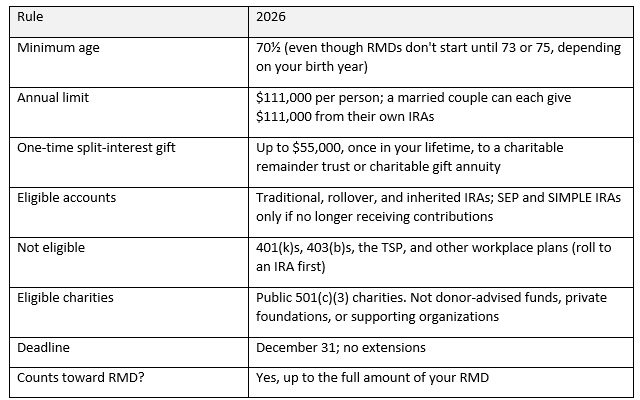
One point worth repeating: the check must go directly from the IRA custodian to the charity. If you take the distribution yourself and then write a check, it is just a taxable withdrawal followed by a regular donation.
A Simple Example
Meet a hypothetical married couple, both 75, filing jointly. They have $85,000 a year in pension and other taxable income, a $40,000 RMD, and they give $10,000 a year to their church. They take the standard deduction.
In the first column they take the full RMD and write the church a check. In the second, $10,000 of the RMD goes straight to the church as a QCD.
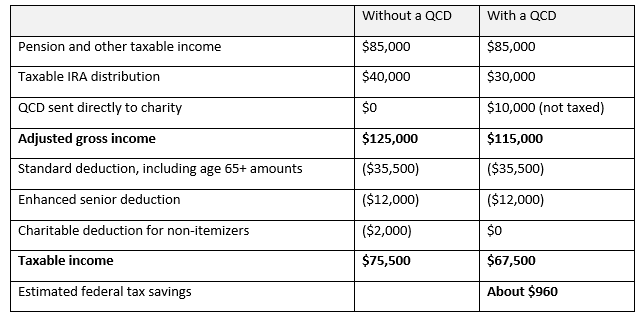
Same RMD satisfied. Same $10,000 to the church. But $8,000 less taxable income, which saves about $960 in the 12% bracket. In the 22% or 24% bracket, the same move would save roughly $1,760 to $1,920.
Notice the $2,000 line. Starting in 2026, non-itemizers can deduct up to $2,000 (married) or $1,000 (single) of cash gifts, as Schwab explains. That narrows the gap a little, but it only covers the first $2,000. The QCD covers all $10,000.
The real savings can be larger. A lower AGI can mean less of your Social Security gets taxed, and it can keep you under thresholds for Medicare premium surcharges (IRMAA) or the senior deduction phaseout. Medicare looks back two years: 2026 IRMAA surcharges start at $218,000 of 2024 modified AGI for married couples ($109,000 for single filers). That means a QCD you make in 2026 lowers the income Medicare will use to set your 2028 premiums. Separately, the $6,000 senior deduction starts phasing out at $150,000 ($75,000 single), per the Schwab 2026 Tax & Retirement Reference Guide. Those effects are on top of the bracket math above.
Hypothetical illustration using 2026 federal figures from the IRS and the Schwab 2026 Tax & Retirement Reference Guide. It ignores state taxes and any Social Security taxation changes. Your numbers will differ.
Who Should Consider a QCD
A QCD is worth a serious look if you:
Are 70½ or older and already give to charity
Take the standard deduction, so your gifts produce little or no tax benefit today
Have RMDs you don't need for living expenses
Are close to a tax threshold, such as the next bracket, the Medicare IRMAA tiers, or the point where more of your Social Security becomes taxable
Want to shrink your traditional IRA over time, which also shrinks future RMDs and the taxable balance your heirs inherit
Are married and both have IRAs, since each spouse gets their own $111,000 limit
It is probably not the right tool if you need the IRA income to live on, want your gift to go to a donor-advised fund or family foundation, or are under 70½. Military retirees with most of their savings in the TSP will need to roll some of it into an IRA first.
QCD, Cash, or Appreciated Stock? How to Decide
A QCD is a great tool, but it isn't automatically the best way to give. For most people, the choice comes down to three options.
Give through a QCD. If you don't need part of your RMD, a QCD keeps that money out of your income and still counts toward the RMD (Fidelity). If you take the standard deduction, this is usually the most efficient way to give.
Take the RMD and give cash. This is what most people do by default, and it often costs more. You pay tax on the full RMD and may get little or nothing back as a deduction. Even if you itemize, the new 2026 limits on charitable deductions can tip the math toward a QCD. In one illustration, a single retiree who used a QCD instead of an itemized cash gift lowered taxable income by about $19,000 (Schwab).
Give appreciated stock. If you itemize, are in a higher bracket, and own stock you've held more than a year with a large gain, donating the stock can beat a QCD. You skip the capital gains tax and deduct the full market value. At high income levels, the side benefits of a QCD, like a smaller Medicare premium, tend to be modest by comparison (J.P. Morgan). Stock can also go to a donor-advised fund or family foundation, which a QCD can't.
Put together, a reasonable way to think about it looks like this:
You take the standard deduction. A QCD will usually be the most tax-efficient way to give from your IRA.
You itemize and give modest amounts. A QCD often still wins, especially with the new 0.5% of AGI floor on itemized charitable deductions that began in 2026.
You itemize, are in a high bracket, and own stock with large gains. Compare a stock gift against a QCD before deciding. Many people use both.
You want to give through a donor-advised fund or family foundation. A QCD can't go there, so stock or cash is the path.
These are starting points, not answers. The right mix depends on your bracket, your other deductions, your Social Security, and your Medicare premiums, and it can change year to year. It is worth running your own numbers with an advisor and your tax preparer before December.
How to Make a QCD the Right Way
The process is simple, but the details matter:
Confirm the charity qualifies. It must be a public 501(c)(3). You can check using the IRS Tax Exempt Organization Search.
Do the QCD before you take the rest of your RMD. The first dollars out of your IRA each year count toward your RMD. Once you have already taken your RMD as cash, a later QCD can't make that income go away.
Ask your IRA custodian for a QCD. Most custodians, including Fidelity, have a dedicated form or online request. The check is made payable to the charity, not to you.
Start early. The deadline is December 31 with no extensions, and the charity has to receive the funds. Aim for early December at the latest.
Get a receipt. Ask the charity for a written acknowledgment showing the amount and stating you received nothing in return.
Tell your tax preparer. This is the step that matters most. See the note below.
The step most people miss: reporting it. Your Schwab Form 1099-R won't say that any of your distribution went to charity. It reports the full amount as a normal distribution, so on paper a QCD looks exactly like money you took for yourself. It's up to you to tell your tax preparer how much of your RMD went to charity, so they can report that portion as a QCD and keep it out of your taxable income. If no one flags it, the full distribution gets taxed and the effort behind the QCD is wasted. If you need it, we can provide a summary of your QCDs for the year to share with your CPA.
Tip from our team: If you'd like to use a QCD for part of your RMD, we recommend having Schwab send the check directly to the 501(c)(3). That gives us certainty the funds leave your account in the tax year you want. Just don't wait until the last minute to request it.
If your Schwab IRA has a checkbook, you can also write a check directly to the charity. But we have seen charities hold these checks and cash them late, which can push the QCD into the next tax year. That's why we prefer having Schwab send it.
State note: QCDs aren't subject to federal withholding, but state tax rules can differ, according to Fidelity. Check how your state treats them before you give.
Common Mistakes to Avoid
Not telling your tax preparer. This is the one we see missed most. Your 1099-R won't show the QCD, so if you or your CPA don't report it, the full distribution gets taxed.
Taking the money yourself first. If the IRA pays you and you then write a check, it isn't a QCD. It's taxable income and a regular donation.
Taking your RMD early in the year, then trying a QCD. The QCD has to come out before the RMD is met to reduce that year's taxable RMD.
Sending it to a donor-advised fund or private foundation. Neither qualifies, per Fidelity and J.P. Morgan.
Getting something back. Gala tickets, dinners, or other benefits in exchange can disqualify the gift.
Giving from a 401(k) or the TSP. QCDs only work from IRAs. Roll the money to an IRA first.
Assuming extra giving carries forward. A QCD larger than this year's RMD does not count toward next year's RMD.
Double-counting the deduction. Because a QCD is already excluded from income, you can't also deduct it as a charitable gift.
Waiting until late December. Processing and mail delays can push the gift into next year.
Next Steps
If you're 70½ or older and give to charity, a QCD may let you do the same good with fewer tax dollars. With the December 31 deadline coming up, now is a good time to look at this year's RMD, your giving plans, and whether a QCD, a stock gift, or a mix of both makes the most sense for you.
If you'd like help running the numbers, give us a call.
JAMES GRIFFIN, MBA, CFP® Managing Principal, Occidental Asset Management
Written on October 22, 2026
This article is for educational purposes only and is not individualized investment, tax, or legal advice. Tax rules change, and the right approach depends on your personal circumstances. Examples are hypothetical and for illustration only. Please consult a qualified tax professional before making any decision.
Sources
Fidelity Investments, "Qualified Charitable Distributions (QCDs)," fidelity.com, accessed October 22, 2026
Hayden Adams, Charles Schwab, "Reducing RMDs With QCDs," schwab.com, January 20, 2026
J.P. Morgan Private Bank, "Are Qualified Charitable Distributions Always the Best Tax-Saving Move?" privatebank.jpmorgan.com, accessed October 22, 2026
Charles Schwab, "2026 Tax & Retirement Reference Guide," schwab.com, 2026 edition (Schwab Center for Financial Research, SCFR 1225-EPV0)
Internal Revenue Service, "IRS Releases Tax Inflation Adjustments for Tax Year 2026," irs.gov, October 9, 2025