
Written by James Griffin · Oct 23, 2026
Why This Matters
Spouse Survivor Benefit Plan (SBP) coverage costs 6.5% of the base amount you elect, taken out of your military retired pay every month before federal taxes. That's the sticker price, and it isn't the whole story.
The premium comes out of every retired paycheck for decades, and what it buys is income for your spouse for the rest of their life. Misread the cost, and you either pay for more than you meant to, or decline something you never actually priced.
In our experience, most couples know the 6.5%. Very few can say what it's charged on, what it really costs after taxes, or when the payments stop. This post covers all three.
If you're not married and have no children, spouse SBP doesn't apply to you. Guard and Reserve members have their own version, Reserve Component SBP, with added cost options.
What Is the SBP Premium?
The SBP premium is what you pay, out of retired pay, so your surviving spouse receives a monthly annuity for life. One number drives both sides: the base amount you elect.
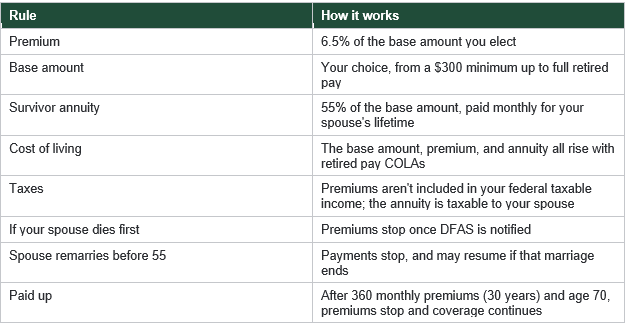
These rules come from the DoD's pages on spouse coverage and paid-up SBP. The flat 6.5% applies if you entered service on or after March 1, 1990 and are retiring for length of service, which covers nearly everyone retiring today. Earlier entrants pay the lesser of 6.5% or an older formula.
One more change people still miss: survivors used to have SBP reduced if they also received Dependency and Indemnity Compensation (DIC) from the VA. That offset was fully eliminated on January 1, 2023, and eligible survivors now receive both in full (Military OneSource).
A Simple Example
Take a married O-5 retiring with $6,000 a month in gross retired pay. Their spouse earns $90,000 a year. Filing jointly with the 2026 standard deduction of $32,200, the household lands in the 22% federal bracket either way, since that bracket runs from $100,800 to $211,400 of taxable income (IRS). They compare full SBP coverage to declining it.
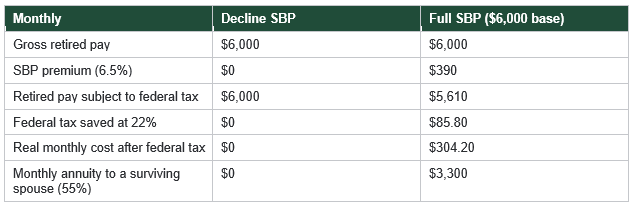
The sticker price is $390 a month. The real cost is about $304, or roughly 5.1% of the base amount, which is $3,650 a year. In exchange, a surviving spouse would receive $3,300 a month for life, adjusted for inflation. In a higher bracket the real cost drops further: about $296 a month at 24%, and about $265 at 32%.
This example is hypothetical. It uses 2026 federal brackets and the married filing jointly standard deduction, a $6,000 base amount, and a $90,000 spouse salary. It ignores state taxes, future COLAs, the paid-up rule, and the tax your spouse would owe on the annuity.
Who Should Pay Attention
Married service members within a year or two of retirement
Couples who've heard "6.5%" but never priced it after taxes
Households where the spouse has little income or retirement savings of their own
Anyone comparing SBP to a life insurance quote
Anyone whose earlier thinking assumed the old SBP-DIC offset
Souse SBP is probably not your question if you're unmarried with no children, or your spouse has substantial income and assets of their own and the household doesn't depend on retired pay. Even then, it's worth pricing before declining, because declining is permanent.
How Much Coverage to Elect
The lever isn't on or off. It's how much. Whatever base amount you choose, the ratio never changes: 6.5% goes in, 55% comes out.
Full base amount. Your full retired pay is the base. The premium and the survivor benefit are both as large as they can be. Using the example above, that's about $304 a month after federal tax for a $3,300 monthly annuity. This is also the default if you're married and do nothing.
Partial base amount. You pick a lower number, down to the $300 floor. Cut the base in half to $3,000, and the premium drops to $195 (about $152 after tax at 22%) while the annuity drops to $1,650. This can fit when your spouse has solid income or savings of their own, but it's a reduced election, so your spouse has to agree in writing.
Decline. No premium, no survivor annuity. Retired pay stops when you die. This also requires your spouse's written agreement, and for a married retiree it's effectively permanent.
A few rules of thumb:
Price SBP on an after-tax basis, never on the 6.5% sticker.
Compare it to life insurance on the same terms: after-tax cost against after-tax benefit, over the whole horizon on both sides.
Give real weight to the inflation adjustment. A fixed benefit and a COLA-adjusted one can drift far apart over 25 or 30 years.
Remember the premium rises with every COLA until you're paid up.
Treat 55% of a base amount as one piece of a survivor income plan, not the whole plan.
The right base amount is usually a range, and where you land depends on your spouse's income, your other savings, your health, and your ages. It's worth running both ends of that range with an advisor and your tax preparer before you sign.
When the Premiums Stop, and How to Keep the Cost in Check
SBP isn't a bill you pay forever. Coverage becomes paid up when two conditions are both met: 360 monthly premiums (30 years) and age 70. Both, not either. After that, premiums stop and coverage continues, still with COLAs (DoD Military Compensation).
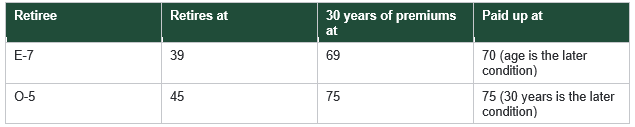
Whichever condition comes later sets the finish line. That changes the lifetime cost picture compared with "6.5% forever," and it's the piece most quick comparisons to term life insurance leave out.
Choose the base amount on purpose. Write down the number you'd actually elect instead of defaulting to full retired pay.
Run it after taxes. Pull last year's return, find your federal bracket, and price the premium net of tax.
Know your paid-up date. Work out which condition you'll hit last.
Tell DFAS about life changes. If your spouse dies first or you divorce, premiums stop once DFAS is notified.
Plan cash flow for the early years. The premium is a real reduction in income from your first retired check, and it grows with each COLA.
State note: States differ on whether SBP premiums reduce state taxable income and how they tax the annuity your spouse receives. Many also exempt some or all military retired pay. Check your state's rules before relying on the after-tax math.
Common Mistakes
Never actually picking a number. If you're married and do nothing, the base amount defaults to full retired pay. That can be the right call, but it should be a choice.
Comparing the sticker price to a life insurance quote. Compare after-tax cost to after-tax benefit, over the full horizon.
Ignoring the inflation adjustment. A COLA-adjusted benefit and a fixed one can end up a long way apart.
Assuming you pay forever. Premiums stop once you've hit both 30 years of payments and age 70.
Working from the old DIC offset. Since January 1, 2023, eligible survivors receive SBP and DIC in full.
Forgetting the survivor's side. The annuity is taxable to your spouse, and it stops if they remarry before 55.
Underestimating the early-year cash flow hit. With kids still at home or in college, the premium is a real cost, not a rounding error.
Next Step
Most couples have never picked their SBP number, let alone priced it after taxes. We'll run your own base amount and bracket and show what each option costs and buys over a lifetime. If that sounds helpful, give us a call.
JAMES GRIFFIN, MBA, CFP® Managing Principal, Occidental Asset Management
Written on October 23, 2026
This article is for educational purposes only and is not individualized investment, tax, or legal advice. SBP and tax rules are set by federal law, agency regulations, and state law, and they can change. Examples are hypothetical and do not represent actual clients or results. Occidental Asset Management is not affiliated with or endorsed by the Department of Defense, the VA, DFAS, or any government agency. Verify current rules and your own figures with the responsible agency, and consult a qualified professional about your situation.
Sources
DoD Military Compensation and Financial Readiness, "SBP Spouse Coverage: Costs and Benefits," militarypay.defense.gov, accessed October 23, 2026
DoD Military Compensation and Financial Readiness, "Paid-up SBP," militarypay.defense.gov, accessed October 23, 2026
Military OneSource, "The Survivor Benefit Plan: Phase-Out of the SBP-DIC Offset Frequently Asked Questions," militaryonesource.mil, accessed October 23, 2026
Internal Revenue Service, "IRS releases tax inflation adjustments for tax year 2026, including amendments from the One, Big, Beautiful Bill," irs.gov, October 9, 2025