
Written by James Griffin · Oct 23, 2026
Why This Matters
Two of your three big military retirement decisions lock in for good: your pension and your Survivor Benefit Plan (SBP). Your Thrift Savings Plan (TSP) stays open, with one exception inside it.
The catch is timing. The deadlines for the locked decisions land before your retirement date, not on it. In our experience, people rarely get these wrong because they don't understand them. They get them wrong because a deadline arrived before the conversation did.
This post maps when each piece locks, what exits exist afterward, and the one TSP move you can't take back. Knowing which kind of decision you're holding changes how fast you should move on it.
If you're separating short of 20 years with no pension coming, only the TSP part applies to you.
Prefer to watch? This post goes with our video, Which Military Retirement Elections Lock In Forever (and Which One Stays Open), on YouTube.
What Locks, and When
The pension doesn't lock on one day. It locks in stages, and some of it was settled years ago.
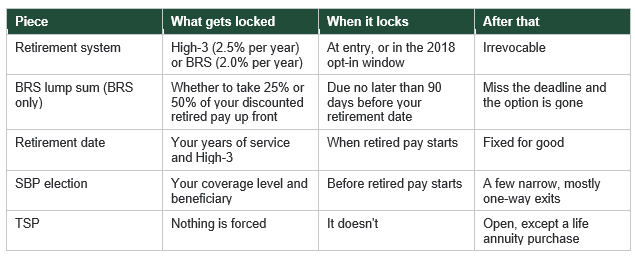
The retirement system. If you entered service on or after January 1, 2018, you're under BRS automatically. If you entered earlier, you're under High-3 unless you opted in during 2018, which was open to active-duty members with fewer than 12 years of service at the end of 2017 (DoD Military Compensation).
The BRS lump sum. Under BRS you can take 25% or 50% of the discounted value of your future retired pay up front. In exchange, your monthly retired pay is reduced to 75% or 50% until full Social Security age, which is 67 for most people. The election has to be made no less than 90 days before your retirement date (DoD guide to the BRS).
SBP. If you're married when you retire, you're enrolled automatically at full spouse coverage. Declining, reducing, or choosing child-only coverage takes an election, plus your spouse's written agreement, before retired pay starts. After that, the election is set.
A Simple Example
Picture two people with the same retirement date, June 1, 2027. One is an O-5 at 23 years under High-3. The other is an E-7 at 20 years who opted into BRS in 2018 and wants the lump sum.
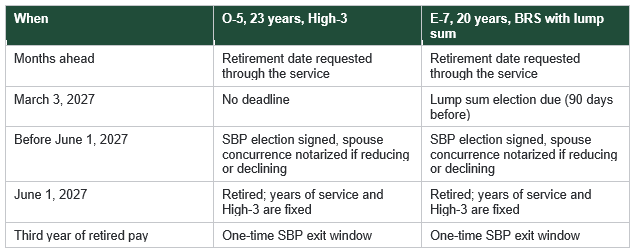
Same date on their orders, different calendars. The E-7's first hard deadline lands three months before anyone plans a ceremony. That's why the useful habit is counting backward from your retirement date, not down to it.
This example is hypothetical. It uses a June 1, 2027 retirement date and the 90-day lump sum deadline. It ignores service-specific processing timelines, which often require paperwork even earlier, and it doesn't cover Guard or Reserve retirements.
Who Should Pay Attention
Active-duty members with a 20-plus-year retirement inside the next year or two
BRS members weighing the lump sum, since that deadline comes first
Married service members and their spouses, since SBP defaults to full coverage and changing that takes both of you
Retirees within the first three years of retired pay who are second-guessing SBP
Anyone considering a TSP annuity, the one permanent move inside the TSP
This is probably not your calendar if you're separating short of 20 years with no pension. Only the TSP part applies. Guard and Reserve members run on a different clock: the SBP election is due within 90 days of receiving the 20-year letter.
The Exits, and the One Door That Closes
SBP locks the day retired pay starts, but there are a few exits afterward. Notice which way they swing.
Exit one: the third-year window. During months 25 through 36 of retired pay, you can drop SBP. Your spouse has to agree, premiums already paid don't come back, and you can't re-enroll. DFAS describes this window as an exit only, not an entrance.
Exit two: life events. Marriage after retirement, a new child, or a divorce each come with their own rules, most with a one-year clock. But if you were married at retirement and declined spouse coverage, DFAS is clear you can't elect it later for a future spouse.
Exit three: open seasons. Only Congress can reopen enrollment. DFAS lists 2023 as the most recent open season, and they're rare. You can't plan a retirement around one.
The TSP's one closing door: a life annuity. Everything else in the TSP stays yours to change after you separate: the fund mix, the beneficiary, how and when you take money out, and whether you keep the account. Buying a life annuity is different. The TSP says you give up control of that money in exchange for lifetime payments, and once purchased, the annuity can't be changed or cancelled. It can be the right call. It just works like your pension and SBP: one signature, no do-over.
A few rules of thumb:
Find your earliest deadline first. For BRS members taking the lump sum, it's 90 days before retirement.
Treat declining SBP as permanent, because for a married retiree it effectively is.
Treat keeping SBP as reversible once, in year three, at the cost of every premium paid so far.
Don't put the TSP on the same deadline as everything else. It doesn't need one.
Before buying a TSP annuity, compare it against installments, which keep the money in your control.
Both sides of the SBP decision cost something, and the right mix depends on your spouse's income, your other assets, and your health. That's a range worth working through with an advisor and your tax preparer before the paperwork is due.
How to Do It Right
Write down your retirement date. Then count backward from it, not down to it.
If you're under BRS, circle the date 90 days earlier. That's the last day for the lump sum election. If you take it, the DoD guide notes you can split it into up to four annual payments, which may help with taxes.
Pull a blank DD Form 2656 months ahead. It's the form that carries your SBP election, your spouse's concurrence, and the BRS lump sum election. Read it together so paperwork day isn't the first time either of you sees it.
Schedule the spouse conversation before the notary. If you're reducing or declining SBP, your spouse's concurrence has to be signed and notarized.
Leave the TSP off the rush list. Review it, but don't force a permanent move like an annuity into the same month as everything else.
Verify with your service. Confirm the current form, deadlines, and your own figures with your Retirement Services Officer or SBP counselor.
State note: States tax military retired pay, the BRS lump sum, and TSP withdrawals differently. Some exempt military retirement income fully or partly. Check your state's rules, and those of any state you plan to move to.
Common Mistakes
Treating SBP like the TSP. "Decline now, fix it later" doesn't work. For a married retiree who declines, outside a rare open season, there is no later.
Treating the TSP like SBP. Rushing a permanent move, like buying an annuity, into retirement month because finalizing something felt responsible.
Planning around the retirement date instead of the first deadline. Under BRS, the lump sum is due 90 days earlier.
Assuming the third-year window works both ways. It only lets you leave SBP. It never lets you in.
Leaving the DD 2656 for the last minute. A notarized spousal signature isn't hard, but it's a bad place to make the decision for the first time.
Thinking the retirement system is still a choice. The High-3 versus BRS question was settled at entry or in 2018.
Next Step
The earliest deadline on your retirement calendar is the one that matters most, and it's usually earlier than people expect. We'll help you build that calendar around your own dates, your SBP decision, and your TSP. If that sounds helpful, give us a call.
If you'd like the walkthrough first, watch the full video on YouTube.
JAMES GRIFFIN, MBA, CFP® Managing Principal, Occidental Asset Management
Written on October 23, 2026
This article is for educational purposes only and is not individualized investment, tax, or legal advice. Military retirement, SBP, BRS, and TSP rules are set by federal law and agency regulations and can change. Examples are hypothetical and do not represent actual clients or results. Occidental Asset Management is not affiliated with or endorsed by the Department of Defense, the VA, DFAS, the TSP, or any government agency. Verify current rules and your own figures with the responsible agency, and consult a qualified professional about your situation.
Sources
DoD Military Compensation and Financial Readiness, "Military Retirement," militarypay.defense.gov, accessed October 23, 2026
DoD Office of Financial Readiness, "A Guide to the Uniformed Services Blended Retirement System," govinfo.gov, July 2018
Defense Finance and Accounting Service, "Changing or Stopping Your Coverage," dfas.mil, updated January 12, 2024
Thrift Savings Plan, "Withdrawals in Retirement," tsp.gov, updated October 19, 2026