
Written by James Griffin · Nov 10, 2026
Why This Matters
A backdoor Roth IRA is a two-step move: you make a nondeductible contribution to a traditional IRA, then convert it to a Roth IRA. It lets people who earn too much to contribute to a Roth IRA directly still get money into one.
Roth IRAs have an income limit. For 2026, a married couple filing jointly can't contribute at all once their income reaches $252,000, and a single filer is shut out at $168,000 (IRS). Conversions are different. As Schwab explains, the income limits on Roth contributions don't apply to conversions. That gap is the back door.
It's worth knowing because money in a Roth IRA can grow and come out tax-free in retirement, and a Roth IRA has no required minimum distributions during your lifetime (IRS Form 8606 instructions).
It also has one rule that trips up a lot of people, called the pro-rata rule. Done right, the conversion can owe little or no tax. Done without checking your other IRAs, most of it can be taxable.
What Is a Backdoor Roth IRA?
It isn't a special account. It's a regular traditional IRA and a regular Roth IRA, used in two steps:
Contribute to a traditional IRA and don't take a tax deduction for it. This is called a nondeductible contribution.
Convert that money to your Roth IRA.
You already paid income tax on the money you put in, so you aren't taxed on it again when you convert. Only earnings, or other pre-tax IRA money, get taxed. You report both steps on IRS Form 8606.
Here are the rules for 2026.
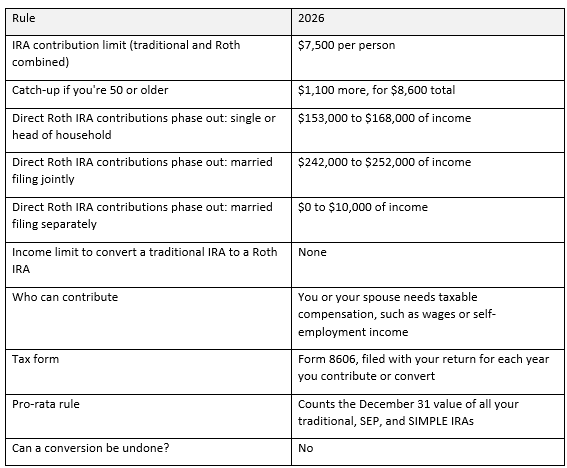
Sources: IRS, 2026 limits and IRS Form 8606 instructions. "Income" here means modified adjusted gross income.
State note: States tax IRA conversions and track after-tax IRA money in their own ways, and some states have no income tax. Check how your state handles it with your tax preparer.
A Simple Example
Mark and Dana are married, both 45, and file jointly. Their income is $300,000, which is over the $252,000 Roth IRA limit. Both have a 401(k) at work, and neither has any other traditional, SEP, or SIMPLE IRA.
Each of them puts $7,500 into a traditional IRA, takes no deduction, leaves it in cash, and converts it to a Roth IRA a few days later.
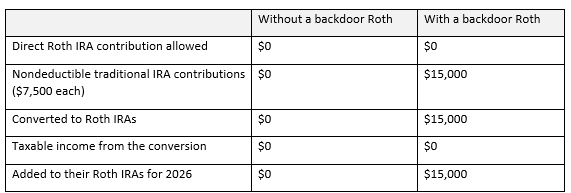
That's $15,000 in Roth IRAs this year that they couldn't have contributed directly. If they repeat it for 10 years at today's limit, that's $150,000 of contributions, before any investment gain or loss. At 50 or older, the limit is $8,600 each, or $17,200 a year for a couple.
This example is hypothetical. It uses the 2026 IRA contribution limit and Roth IRA income limit, and it assumes no earnings between the contribution and the conversion and no other pre-tax IRA balances. It ignores state taxes and investment results. Your numbers will be different.
Who Should Consider It
Your income is over the Roth IRA limit, or close enough that you can't be sure you'll qualify.
You're already saving enough in your 401(k) or TSP to get the full match, and you want more tax-free savings.
You have no pre-tax money in traditional, SEP, or SIMPLE IRAs, or you can move it into a workplace plan.
You won't need this money for at least five years, and ideally not until after 59½.
You or your tax preparer will file Form 8606 every year you do it.
It's probably not for you if your income is under the limit, because you can simply contribute to a Roth IRA directly. It's also a poor fit if you have a large rollover IRA you can't move, since most of each conversion would be taxed.
If you're retiring from the military: two things to watch. First, you need taxable compensation to contribute to an IRA. Wages from a second career count. Retired pay by itself generally doesn't, so confirm this with your tax preparer. Second, the pro-rata rule looks at IRAs, not the TSP. If you roll your traditional TSP into an IRA when you retire, that balance counts against every backdoor Roth you do afterward. If a backdoor Roth is in your plans, decide that before you move the TSP.
The Pro-Rata Rule and Your Options
This is the decision that matters most. The IRS doesn't let you convert only your after-tax dollars. It treats all your traditional, SEP, and SIMPLE IRAs as one pot, measured on December 31 of the year you convert, and taxes the conversion in proportion (IRS Form 8606 instructions). Your 401(k) and TSP don't count. Neither do your spouse's IRAs, since each spouse files their own Form 8606.
Here's what that looks like. Say Mark also had a $92,500 rollover IRA from an old 401(k).
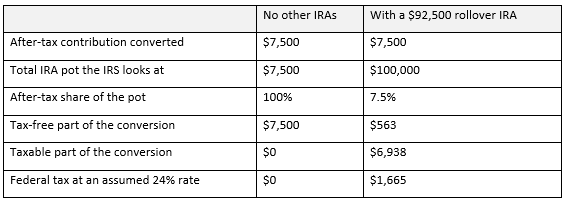
Hypothetical. Assumes no earnings and a 24% federal rate for illustration. The untaxed after-tax dollars aren't lost. They stay in the IRA as basis and are tracked on Form 8606.
If you have pre-tax IRA money, you have four ways to go.
Move the pre-tax IRA into your workplace plan first. Many 401(k)s accept roll-ins of pre-tax IRA money, and the TSP's rules allow it for participants with an existing account (TSP regulations). This fits when your plan accepts it and has investments and costs you're comfortable with. The tradeoff is that you're limited to the plan's investment menu, and the IRA has to be empty by December 31.
Convert the whole pre-tax IRA. This fits when the balance is small or you're in a low-income year, such as a gap between jobs or the early years of retirement. The tradeoff is a tax bill now on everything you convert. The extra income can also raise Medicare premiums and the tax on Social Security benefits (Schwab). Plan to pay the tax from savings outside the IRA. Money pulled from the IRA to cover it counts as a withdrawal, and under 59½ it can bring a 10% penalty (Vanguard).
Do it anyway and accept the tax. Part of each conversion is taxable, and the rest of your after-tax money stays behind as basis. Fidelity makes the same point: converting after-tax dollars can pull some of your pre-tax balance along with it, so expect some tax. This can fit when the pre-tax balance is small next to the contribution. The tradeoff is tax each year and more recordkeeping.
Skip it and save another way. A Roth 401(k) or Roth TSP has no income limit on contributions, and the 2026 limit is $24,500, or $32,500 if you're 50 or older (IRS). The tradeoff is that Roth contributions there don't lower your taxable income today the way pre-tax contributions do.
A few rules of thumb:
No pre-tax IRA money on December 31: the backdoor Roth is usually clean.
Pre-tax IRA money you can roll into a 401(k) or TSP: move it first, then do the backdoor Roth.
A small pre-tax balance: compare the tax on converting all of it with the hassle of tracking basis for years.
A large pre-tax balance you can't move: the Roth option inside your workplace plan is usually the simpler path.
Treat these as a range of options to talk through with your advisor and tax preparer, not a rule. The right answer depends on your tax bracket now, what you expect it to be later, and what your workplace plan allows.
If You're Self-Employed: The Solo 401(k) Angle
Business owners with no employees have an option most people don't. A solo 401(k), which the IRS calls a one-participant 401(k), is a regular 401(k) that covers a business owner with no employees, or the owner and a spouse. If a SEP IRA or an old rollover IRA is what's blocking your backdoor Roth, a solo 401(k) may be the way to clear it.
Here's the idea:
Set up a solo 401(k) that accepts roll-ins. Not every plan does, so check the plan document before you open one.
Roll your pre-tax SEP and rollover IRA money into it. The IRS rollover chart allows traditional and SEP IRA money to move into the pre-tax side of a qualified plan such as a 401(k). Workplace plans don't count in the pro-rata math, so this takes those dollars out of the calculation. Only pre-tax money can move. After-tax IRA money stays behind.
Do the backdoor Roth each year. With no pre-tax IRA balance on December 31, the conversion can be clean.
Some solo 401(k) plans go a step further and allow after-tax contributions that can be moved to the plan's Roth account. That's often called a mega backdoor Roth, and it can sit alongside the regular backdoor Roth. It depends entirely on how the plan is written. The IRS is clear that in-plan Roth rollovers are available only if the plan permits them, and any untaxed amount you move is taxable that year. This one deserves its own article.
The tradeoffs: a solo 401(k) follows the same rules as any other 401(k), with a plan document and contribution limits tied to your business income. Once the plan holds $250,000 or more at year-end, it generally has to file an annual report on Form 5500-EZ. And if you hire employees who meet the plan's eligibility rules, you have to include them, which adds testing and cost (IRS).
Tip from our team: In our experience, the off-the-shelf solo 401(k) at many brokerages doesn't include every feature this takes. We've worked with self-employed clients who used a third-party administrator to write the plan, with the account held at a brokerage custodian. Talk with your CPA before you set anything up, because the plan design and the timing both matter.
How to Do It Right
Check your IRAs first. List every traditional, SEP, and SIMPLE IRA you own and the balance in each. If there's pre-tax money, pick one of the options above before you contribute.
Open both accounts. You need a traditional IRA and a Roth IRA. Having them at the same firm makes the conversion a simple transfer.
Make the nondeductible contribution. Up to $7,500 for 2026, or $8,600 if you're 50 or older. You can generally make a contribution for a tax year up to the filing deadline the following April.
Keep it in cash until you convert. Any earnings between the contribution and the conversion are taxable, so there's no reason to invest it yet.
Convert to the Roth IRA. Ask your custodian for a Roth conversion of the full balance. Then invest it inside the Roth IRA.
Make sure you're at zero on December 31. No pre-tax balance in any traditional, SEP, or SIMPLE IRA at year-end.
File Form 8606. It reports the nondeductible contribution and the conversion. Each spouse files their own. Keep copies for as long as you own the accounts.
State note: If your state has an income tax, ask your tax preparer how it treats the conversion and whether it needs its own record of your after-tax contributions.
Common Mistakes
Forgetting an old IRA. A rollover IRA from a past job, or a SEP IRA from a side business, counts in the pro-rata math even if it sits at a different firm.
Rolling a 401(k) or TSP into an IRA later the same year. The IRS looks at your balance on December 31, not on the day you convert. A rollover in November can make a clean conversion from February mostly taxable.
Skipping Form 8606. Without it, there's no record that your contribution was already taxed, and you could end up paying tax on the same dollars twice. The IRS can also charge a $50 penalty for not filing it (IRS).
Investing before converting. Gains in the traditional IRA are taxable when you convert. Convert first, then invest.
Assuming you can undo it. Conversions made in 2018 or later can't be reversed (Schwab). Run the numbers before you convert, not after.
Mixing up tax years. A contribution made in early 2027 for 2026 goes on your 2026 Form 8606. The conversion goes on the form for the year it actually happens.
Treating it like a savings account. Earnings in a Roth IRA generally come out tax-free only after you're 59½ and five years have passed. Each conversion also starts its own five-year clock for penalty purposes (Vanguard). If you'll need the money within five years, Fidelity suggests thinking twice. This is long-term money.
Contributing without earned income. No taxable compensation for you or your spouse means no IRA contribution, and an excess contribution carries its own penalty.
Next Steps
Before you contribute, pull together a list of your IRAs and their balances, and find out whether your workplace plan accepts roll-ins. Those two answers tell you most of what you need to know. If you'd like help looking at where a backdoor Roth fits in your plan, give us a call.
JAMES GRIFFIN, MBA, CFP® Managing Principal, Occidental Asset Management
Written on November 10, 2026
This article is for educational purposes only and is not individualized investment, tax, or legal advice. Tax rules and limits change, and how they apply depends on your situation. The examples are hypothetical and are not a projection or guarantee of any result. Consult a qualified tax professional and financial advisor before acting. Occidental Asset Management is not affiliated with or endorsed by the Department of Defense, the VA, DFAS, the TSP, or any government agency.
Sources
• Hayden Adams, "What Is a Roth Conversion? Rules, Taxes, and More," Charles Schwab, August 5, 2026.
• Fidelity Wealth Management, "Is a Roth conversion right for you?" Fidelity, July 1, 2026.
• Vanguard, "IRA Roth conversion," Vanguard, accessed November 10, 2026.
• Internal Revenue Service, "401(k) limit increases to $24,500 for 2026, IRA limit increases to $7,500" (IR-2025-111), IRS.gov, November 13, 2025.
• Internal Revenue Service, "Instructions for Form 8606 (2025), Nondeductible IRAs," IRS.gov, accessed November 10, 2026. Latest edition available. The 2026 dollar figures in this post come from the IRS release above.
• Internal Revenue Service, "One-participant 401(k) plans," IRS.gov, last updated April 9, 2026.
• Internal Revenue Service, "Rollover Chart," IRS.gov, accessed November 10, 2026.
• Internal Revenue Service, "Roth acct in your retirement plan," IRS.gov, last updated November 16, 2025.
• Federal Retirement Thrift Investment Board, "5 CFR Part 1600, Subpart D, Rollovers from Other Qualified Retirement Plans," eCFR.gov, accessed November 10, 2026.